Unfamous Places recommends
Granite. Rain. Bagpipes. The finest seafood in Europe. A cathedral that has drawn pilgrims for twelve centuries. And a coastline where the Atlantic breaks against the end of the known world.
Galicia is the northwestern corner of Spain, and it bears almost no resemblance to the rest of the country. Green rather than arid. Atlantic rather than Mediterranean. Bagpipes rather than flamenco. The regional language, Galego, is closer to Portuguese than to Castilian Spanish. The landscape — granite mountains, drowned river valleys (the rías), dense forest, wild Atlantic coast — looks more like Ireland or Brittany than Andalucía. The people are direct, proud, and utterly committed to the quality of their food. Most visitors to Spain have never been.
The Rías Baixas — the series of drowned river valleys on the southwest coast — are the most productive shellfish-producing waters in Europe. The combination of cold, clear Atlantic water, tidal flow, and the organic richness of the estuarine sediment produces mussels, clams, razor clams, scallops, percebes (goose barnacles), and octopus of a quality unavailable anywhere else. The regional fish markets are extraordinary. The simplest preparation — pulpo a feira, boiled octopus with olive oil, paprika, and sea salt on a wooden board — is one of the finest dishes on earth.
The Cathedral of Santiago de Compostela has been the destination of the Camino pilgrimage since the 9th century — one of the three great pilgrimage sites of medieval Christendom alongside Rome and Jerusalem. The Baroque facade facing the Praza do Obradoiro is among the most dramatic pieces of architecture in Spain. The experience of being in the square when a group of pilgrims arrives — walking in to applause from the people already there, weeping, embracing strangers — is one of the most moving things available to a secular traveller in Europe.
The Albaríño grape, grown on the terraced hillsides of the Rías Baixas sub-regions — and particularly in the valleys of the Salneśs and Condado do Tea — produces white wines of extraordinary quality: crisp, aromatic, with a salinity that mirrors the sea it looks over. Outside Spain, they are known. Inside Galicia, they are the local table wine, poured by the jug in good restaurants. The Cambados wine festival in August is the finest single day in Galician viticulture.
April–May. The landscape is intensely green from the Atlantic rains. Holy Week in Santiago is spectacular. The coast is quieter and cheaper.
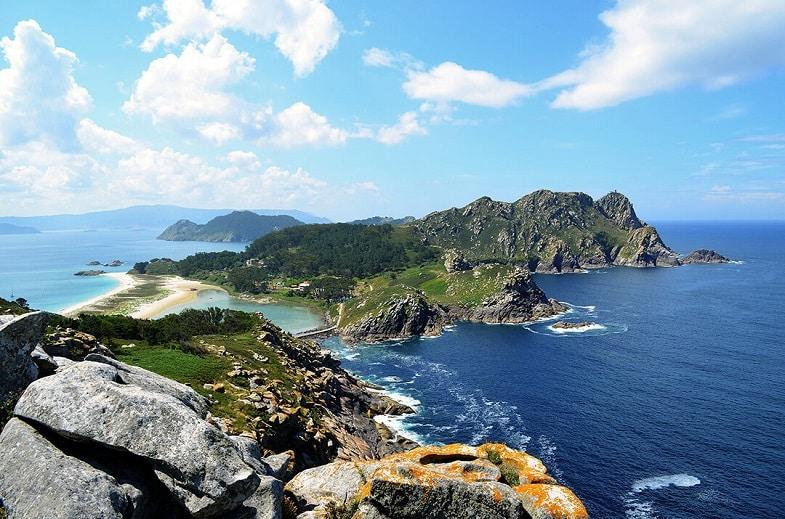
June–September. The Cíes Islands are open. The beaches are at their best. The Albariño festival in Cambados in August. Long evenings on the rías. The peak season — book ahead.
October. The grape harvest, the finest Albariño of the year, golden light on the granite cities, and the crowds gone from Santiago. The best month for food and wine visitors.
November–March. Wet and mild. Santiago’s Baroque streets in the rain have a particular character. The restaurants are full of locals and the tourist menus have disappeared.
Direct flights from London Heathrow and Gatwick, Manchester, and other UK cities on Iberia, Vueling, and Ryanair. The airport is 11km east of the city. A taxi into the historic centre takes fifteen minutes. The most practical arrival point for first-time visitors.
Vigo Airport is well-connected for those based in the Rías Baixas. A Coruña serves the northern coast. Both have good connections from Madrid and other Spanish cities; international direct flights are more limited than Santiago but worth checking for specific itineraries.
The AVE high-speed train connects Madrid Chamartín to Santiago de Compostela in just over five hours. A practical option for those combining Galicia with a Madrid stay. The train arrives in Santiago city centre, within walking distance of the cathedral.
A car is necessary for the Rías Baixas — the best beaches, the wine estates, the coastal villages of Combarro and Cambados, and the ferry to the Cíes Islands are not effectively served by public transport. Hire from Santiago or Vigo airport; the roads are good and distances are manageable.
A perfectly preserved medieval old town without mass tourism — one of the most underrated cities in Spain. Cars banned from the centre for decades. The streets are granite and quiet. Several excellent restaurants including the Michelin-starred Eirado da Leña.
Galicia’s second city — a glasstown of enclosed balconied facades looking out to the Atlantic, a Roman lighthouse (the Torre de Hércules, still functioning) and one of the finest fish markets in Europe. The Marisquería Ríos is the best place in Galicia to eat barnacles.
The Coast of Death — the wild Atlantic cliffs north of Finisterre, where the ancient world believed the land ended and the sea began. Lighthouses, wrecks, extraordinary light, and the pilgrim tradition of burning clothes at Cape Finisterre. Almost no tourists.
Two hours south across the Portuguese border — the natural combination for a longer trip. Porto’s food culture, Douro wine, and the Ribeira waterfront complement Galicia rather than duplicating it. The train from Vigo to Porto takes under two hours.
The inland canyon country of Galicia — the Sil and Miño rivers have cut spectacular gorges through the granite, and the canyon slopes are terraced with the Mencía grape. The monasteries that overlook the rivers are among the finest Romanesque buildings in Spain.
The only city in the world to have its complete Roman walls still intact — a UNESCO site, 2km of wall walkable in their entirety, with towers and gates. Inside, a city of tapas bars where every drink comes with free food. Almost entirely overlooked by visitors to Galicia.