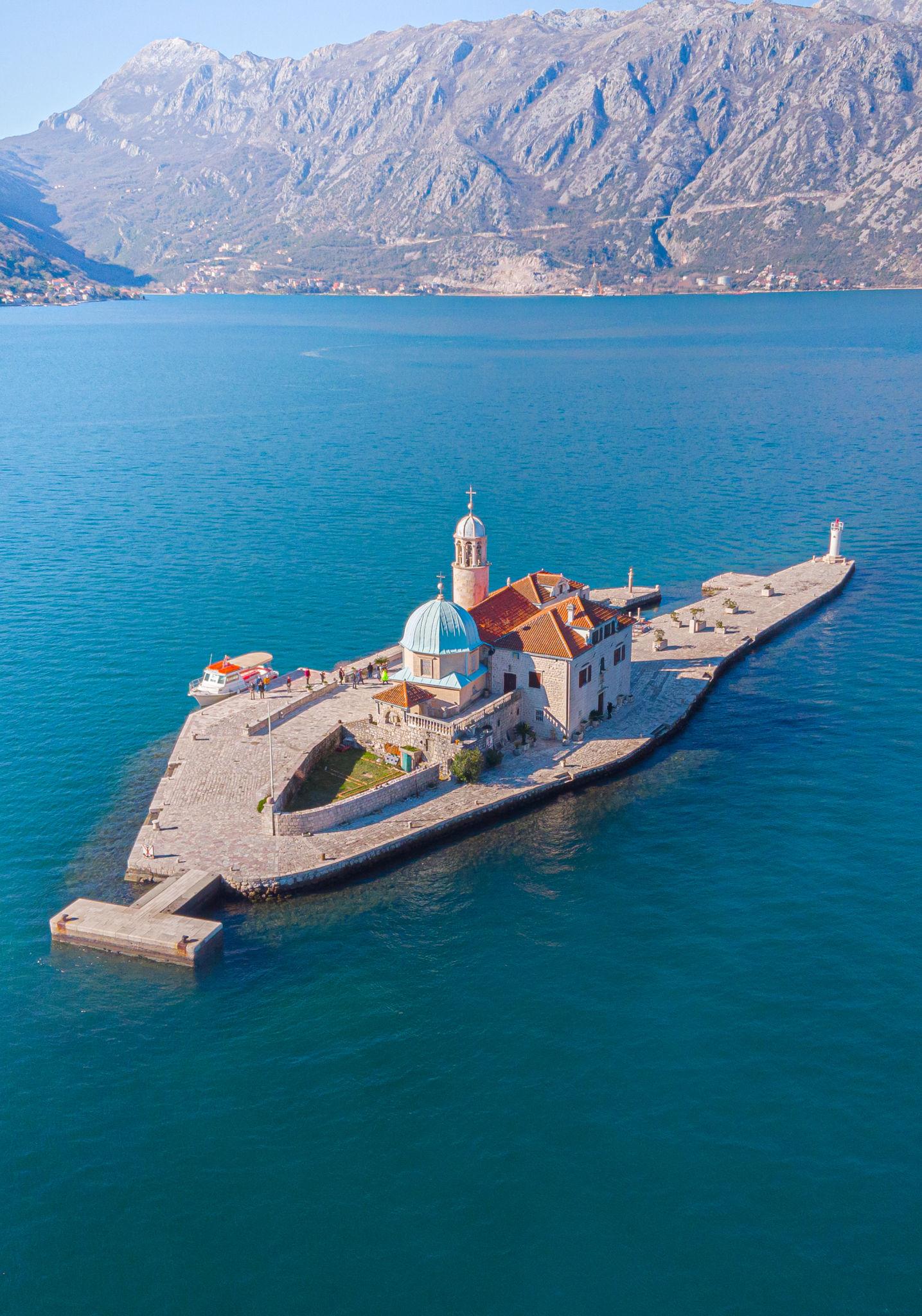
Island
Our Lady of the Rocks — the island that sailors built
Four hundred metres from the Perast waterfront: the only man-made island in the Adriatic. After a sailor found a miraculous icon of the Virgin on a reef in 1452, Perast’s seafarers began following a tradition of dropping a stone into the bay every time they returned safely from a voyage. Over centuries, the reef grew into an island large enough to build a church. The church today contains 2,500 silver votive plaques — each one a gift from a sailor who returned — and 68 oil paintings, including a silk tapestry woven by a local woman over 25 years, using her own hair as thread when she ran out of other material. Water taxis from the Perast waterfront take five minutes. Buy your ticket on the jetty.
Open daily May–October. Water taxi from Perast waterfront: approx. €5 return.
Church
St Nicholas bell tower — one euro, panoramic
The Church of St Nicholas (Crkva Svetog Nikole) dominates the Perast skyline with its 55-metre bell tower — one of the largest on the Montenegrin coast and, for one euro, climbable to the top. The view from the bell tower is the finest in the Bay of Kotor accessible without a hike: the entire sweep of the bay, both islands, the town below, and the karst mountains rising steeply on all sides. The church itself contains works of art from Perast’s maritime golden age including paintings, silver artifacts, and the original icon from Our Lady of the Rocks. Enter the small chapel downstairs before you climb.
Tower climb: €1. Open daily in season.
Culture
Museum of Perast — Bujošvić Palace
In the Bujović Palace — the finest Baroque palace on the Perast waterfront, built in 1694 and now housing the town’s museum — the story of Perast’s extraordinary maritime history is told through paintings, documents, navigational instruments, coins, and the correspondence of the sea captains who made this tiny town one of the most respected naval powers in the Adriatic. The display of votive icons from vessels that survived storms is particularly moving. The building itself is as important as the collection. Allow an hour.
Check seasonal opening hours on arrival.
History
The Baroque palaces — a walk along the promenade
The entire town of Perast is 1.5 kilometres end to end — a twenty-minute walk if you move at pace, considerably longer if you stop. Along the Obala Marka Martinovića (the main waterfront street, named after the sea captain who trained Peter the Great’s officers) you will pass the facades of Baroque palaces built with prize money, trade profits, and Venetian patronage over two centuries. Some are perfectly restored; some are collapsing in a way that makes them more rather than less beautiful. The Smekja Palace still bears the coat of arms of the seafaring family that built it. Walk it at dawn before the day-trippers arrive.
Nature
The bay at dawn and dusk
The most important thing to do in Perast — and the thing that most day-trippers miss — is simply to be there when the light changes. At dawn the bay is glassy, the palaces are lit by low raking sun, and the two islands float in still water with no boats, no voices, nothing moving. At dusk the karst mountains behind the town turn orange and the bay reflects them. The quality of light in the Bay of Kotor at these hours is different from anywhere else on the Adriatic. A terrace table at Riva or Conte, a glass of Krstac white, and the light fading. This is why you came.
Stay at least one night. The bay at dawn is only visible to those who do.
Food
Peraška Torta — eat the town’s own cake
The Peraška Torta is a traditional almond cake made with eggs, sugar, almonds, and rose water — the only food in the world specific to this village, with a recipe that has been passed down within Perast families for centuries. It is served as a dessert in the better restaurants and sold in a handful of small shops along the waterfront. It is sweet, dense, and unlike any other Balkan pastry. Its origins are Venetian — the almond and rose water combination reflects the eastern trading connections of the Adriatic Republic. Order it wherever you see it on the menu. It is the taste of the town.