Unfamous Places recommends
The birthplace of Portugal. The greenest corner of a country that is not green. The wine that invented a category. Baroque staircases. Solares in the Lima Valley. Almost no international visitors.
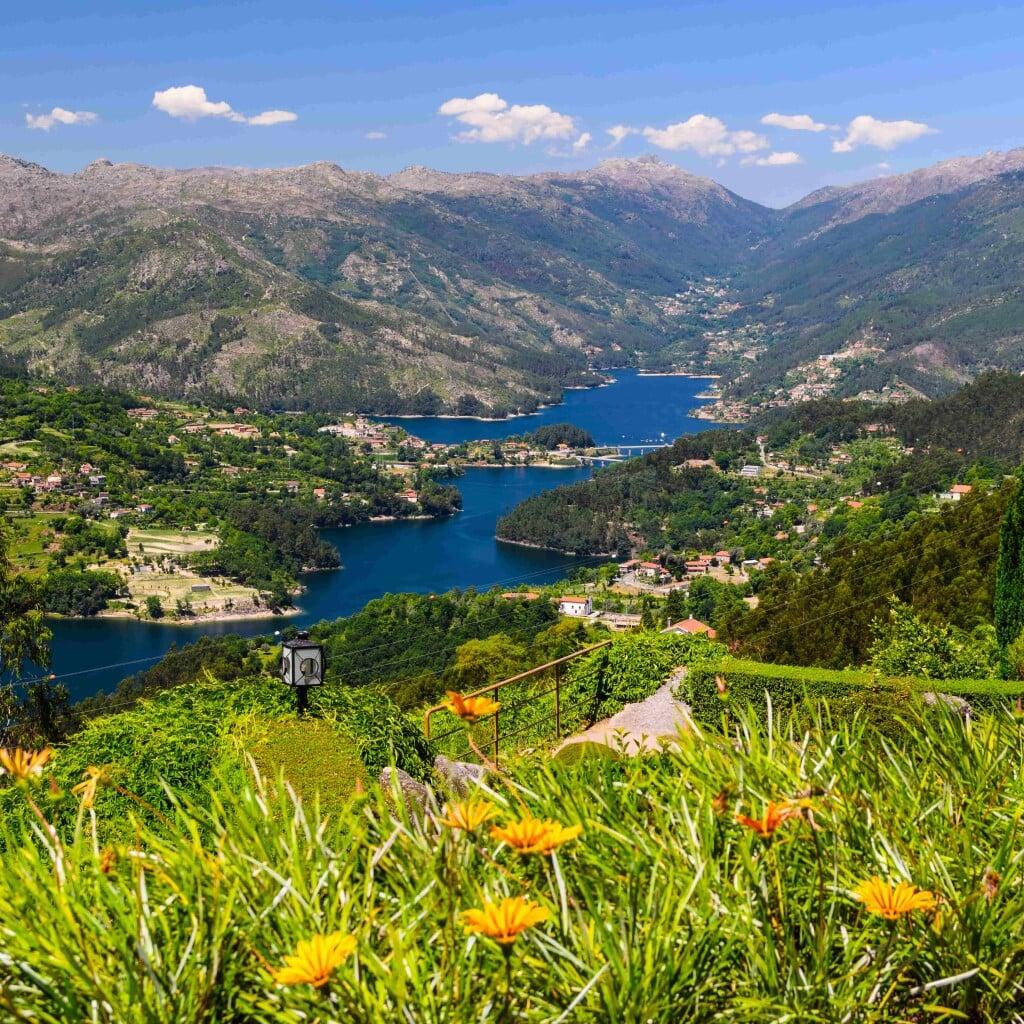
The Minho is the north-western corner of Portugal, bordered by the Atlantic to the west and Spain to the north. It is the wettest and greenest part of the country — a patchwork of mountain meadows and terraced vineyards threaded with lush river valleys. Most visitors go to Porto and never look further. Those who do find Guimarães (the first capital of Portugal), Braga (the religious heart of the country), Ponte de Lima (the oldest town in Portugal), and a national park with wolves and waterfalls an hour from the coast.
Afuído Henriques, the first King of Portugal, was born in Guimarães in 1111 and defeated the Moors at the Battle of São Mamed in 1128, establishing the independence of the Portuguese kingdom. The city’s castle and palace have been preserved in something close to their medieval state. The UNESCO-listed historic centre — cobbled streets, granite arcades, painted town houses — is among the finest in the country. And in the hills above the city, one of the best Michelin-starred restaurants in Portugal occupies a converted textile factory.
Vinho verde is produced across the Minho — a wine style defined by low alcohol, natural effervescence, and the freshness of young grapes harvested early. The Alvarinho grape from the sub-region of Monção e Melgàço produces the finest examples in the country: wines that bear almost no resemblance to the supermarket vinho verde most people know and that represent some of the best value in European wine. The vineyards are grown on overhead pergolas — a tradition that gives the Minho landscape its distinctive green canopy.
The Lima Valley south of Viana do Castelo contains an extraordinary concentration of solares — manor houses built between the 17th and 19th centuries by the Minho’s rural aristocracy. Many have been converted into small hotels; others are still owned by the families who built them and offer rooms to guests under the turismo de habitação scheme. Ponte de Lima — a Roman bridge crossing the Lima River to a medieval town on the far bank — is the oldest town in Portugal. Storks nest on the bridge towers in spring. Almost nobody outside Portugal has been.
March to May. The hills are intensely green, wild flowers cover the roadsides, the rivers run full. Braga’s Holy Week processions are the finest in Portugal.
Warm and busy in August, cooler on the coast. The Romaria da Senhora da Agónia in Viana do Castelo in August is one of the most spectacular festivals in Portugal.
September and October. Grape harvest, golden vineyards, the best value of the year. The light is extraordinary and the crowds absent.
Wet and mild. The region is green even in January. The solares and manor hotels are quiet, peaceful, and significantly cheaper.
Porto’s Francisco Sá Carneiro Airport (OPO) is the gateway. Trains run directly to Braga (55 min), Guimarães (1 hr 10 min), and Viana do Castelo (1 hr 30 min). A hire car gives access to the Lima Valley solares, the wine estates, and Peneda-Gerês National Park, none of which are effectively served by public transport.
The main towns are connected by train and bus, but the solares, wine estates, national park, and smaller villages are only practically reachable by car. A hire car from Porto Airport is the most flexible option. Portuguese roads in the Minho are generally good; the mountain roads to Gerês require care but not a 4x4.
Direct flights from London Heathrow, Gatwick, Stansted, Manchester, and Edinburgh on TAP, Ryanair, easyJet, and British Airways. Porto is well-served and prices are generally reasonable. Flying into Porto and combining it with Minho is the natural structure for a week.
The contrast with Minho could hardly be greater — vast, dry, cork oak plains in place of green river valleys. The same country; a completely different world. Worth combining on a longer Portugal trip if you want to understand what makes each region itself.
The natural gateway to Minho — an hour south, UNESCO-listed, and one of the most interesting cities in Europe. The Ribeira waterfront, the port wine lodges, the Lello bookshop, and a restaurant scene that is pulling well above its weight. Worth at least two nights at either end of the Minho trip.
The Rio Minho forms the border between Portugal and Spain. Galicia on the Spanish side is linguistically and culturally closer to Minho than to Castile — a green, seafood-rich Atlantic region with its own language (Galego, mutually intelligible with Portuguese). Tui faces Valença across the river.
The port wine country an hour south-east of Braga — terraced vineyards on steep schist slopes above the Douro River, the oldest demarcated wine region in the world. River cruise or scenic drive from Porto; spectacular at any time of year.
A perfectly preserved Vauban-style fortress town on a hill above the Minho River, facing the Spanish town of Tui across the water. The twin fortresses are among the finest surviving examples of 17th-century military architecture in Europe. Walk the ramparts in the evening after the day-trippers have gone back to Spain.
The most elegant town on the Atlantic coast of northern Portugal — a fine Gothic church, a temple of Santa Luzia on the hill above (pilgrim church, panoramic views), the gold filigree tradition, and Atlantic beaches fifteen minutes away. Worth a night rather than a day trip.