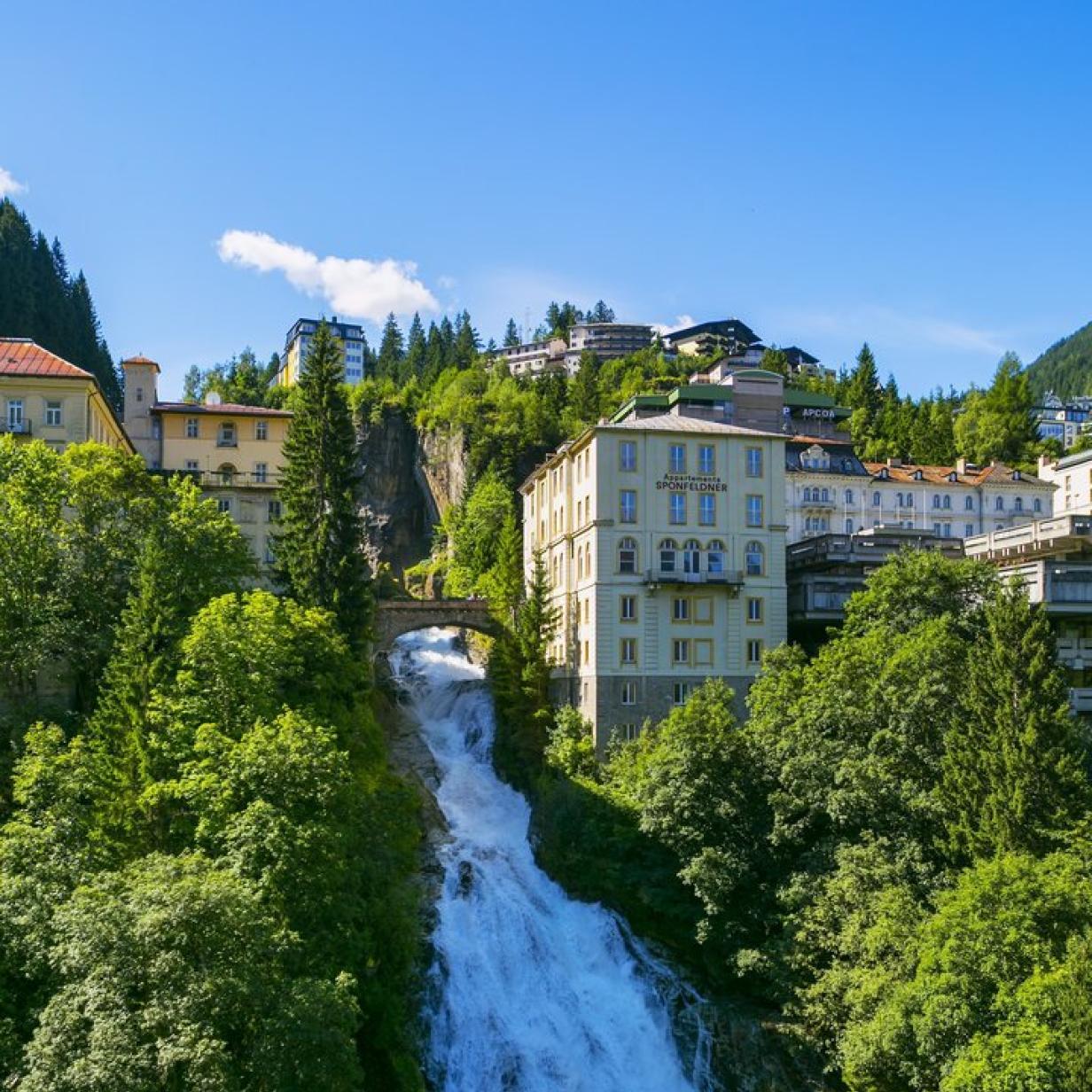
Bad Gastein waterfall through the town — Belle Époque facades and stone bridge
Austria · Salzburg Province

Bad Gastein
the grand hotel awakens

Unfamous Places recommends

A Belle Époque spa resort where Kaiser Franz Joseph took the waters and a 19th-century treaty changed the map of Europe. It fell asleep after WWII. Three grand hotels have just reopened. Almost nobody has noticed yet.

CountryAustria
From Salzburg1 hr 30 min by train
Altitude1,083 metres
Best monthsDec–Mar, Jul–Sep
01

Why Bad Gastein belongs
on your list

A Belle Époque resort that fell asleep and is waking up

Bad Gastein was one of the most fashionable resorts in the Austrian Empire. Kaiser Franz Joseph came every summer. Brahms composed here. Kafka came to write. Kaiser Wilhelm stayed at the Straubinger Grand Hotel, where the treaty between Prussia and Austria was signed in 1865. After the Second World War the guests stopped coming, the grand hotels closed one by one, and the facades fell into a state of magnificent decay. Since 2021, three of the most important historic buildings have been restored and reopened. The window between the revival and the discovery is the moment to go.

A waterfall runs through the centre of the town

The Gasteiner Ache — the mountain torrent that drains the Gastein Valley — drops 341 metres through the town centre in a series of falls that are visible and audible from the main square. The Straubinger Grand Hotel is built directly beside it; you can hear the waterfall from the infinity pool on the roof. In a continent where most Alpine resorts have long since covered their rivers in tarmac and routed them underground, Bad Gastein’s waterfall is still the central fact of the place.

Thermal water at 47°C from a source nobody fully understands

The thermal water that made Bad Gastein famous in the 19th century still flows at 47°C from springs that were already known to the Romans. The water is radon-bearing — a quality that the Austrian medical establishment spent decades debating and that gave rise to the extraordinary Gastein Heilstollen (healing tunnel), where patients with arthritis and respiratory conditions sit in a sealed mountain tunnel for sessions of thermal-radon therapy. The Felsentherme thermal spa is the most civilised way to experience the water without a medical referral.

The Gasteiner Vertrag — history made in a hotel room

In August 1865, Bismarck and the Austrian Foreign Minister Blome met at the Straubinger Hotel in Bad Gastein and signed the Convention of Gastein — the treaty that divided the Duchies of Schleswig and Holstein between Prussia and Austria and set the course for the Austro-Prussian War of 1866. The agreement that reshaped the map of Europe was negotiated in a spa hotel where Eckart Witzigmann — arguably the greatest German-language chef of the 20th century — would later do his training. The restored Straubinger holds both pieces of history without making a fuss about either.

Much of the town has a solid though timeworn elegance — a mountain torrent rushes through the centre, grand facades line the hillsides, and the thermal springs still flow at 47 degrees. The newest chapter is only just beginning.
02

When to go
to Bad Gastein

Winter ✦Exceptional

December to March. Skiing on the Gastein slopes, the thermal spa after a day on the mountain, and the Belle Époque hotels at their most atmospheric under snow.

SpringQuiet

April and May. The ski season ends, the hiking trails open slowly. The thermal spa is at its quietest. Good value, empty hotels.

Summer ✦Exceptional

July and August. Hiking in the Hohe Tauern, the Stubnerkogel suspension bridge, and the thermal spa with mountain views. The town at its most alive since the 19th century.

AutumnGood

September and October. Golden larches, hiking trails still open, the Heilstollen thermal tunnel for the wellness-minded, and the best value of the year.

The Perchtenlaufen — an ancient pagan procession in January, with enormous intimidating masks and considerable noise — is one of the most extraordinary folk traditions in the Austrian Alps. If you are there in January, do not miss it.

03

Getting to
Bad Gastein

By train from Salzburg

1 hr 30 min direct

One of the most beautiful railway journeys in Austria — direct trains from Salzburg Hauptbahnhof to Bad Gastein run several times daily through the Salzach valley and into the mountains. The train arrives at Bad Gastein station, a five-minute walk from the Straubingerplatz. No car needed once you are there.

Fly to Salzburg

SZG · 97 km from Bad Gastein

Salzburg Airport (SZG) has direct flights from London, Dublin, Amsterdam, and other European cities. The train from Salzburg to Bad Gastein is the logical continuation. Alternatively, a hire car gives access to the Hohe Tauern National Park and the surrounding valleys.

From Vienna

3 hrs 30 min by train

Direct or one-change trains from Vienna Hauptbahnhof to Bad Gastein. The route passes through the Salzach valley and is consistently beautiful. Vienna to Bad Gastein is a natural combination — city first, mountains second, or vice versa.

04

Nearby unfamous
places

AustriaHohe Tauern National Park

The largest national park in the Alps — 1,800 square kilometres of glaciers, peaks over 3,000 metres, and the Grossglockner (3,798m, the highest mountain in Austria). The Grossglockner High Alpine Road is one of the great scenic drives in Europe.

From Bad Gastein · Worth a day
AustriaSalzburg

Mozart’s birthplace, the Festung Hohensalzburg, the Altstadt, and a music festival in summer that is among the finest in the world. Worth two or three nights at either end of a Bad Gastein trip — the train connection makes it simple.

1 hr 30 min by train · Worth 2–3 nights
AustriaZell am See

A lakeside town at the foot of the Kitzsteinhorn glacier — swimming in the Zeller See in summer, skiing on the Kaprun glacier year-round, and a handsome historic centre on the lake shore. Less fashionable than it was; well worth a night.

50 min by car · Worth a night
AustriaBad Hofgastein

The next town down the Gastein Valley — lower altitude, broader and warmer, with the main valley spa complex and a more traditional Austrian resort atmosphere. Often combined with Bad Gastein on the Gastein ski area lift pass.

15 min by bus · Half-day
AustriaInnsbruck

The Habsburg capital of Tyrol — the Golden Roof, the Imperial Court Church with the bronze figures of the Habsburgs, and a ski jump that hangs above the city. Two hours west of Salzburg; a natural extension for those with more time.

2 hrs from Salzburg · Worth a night
AustriaHallstatt

The lake village that inspired a thousand tourist photographs — and genuinely beautiful despite the crowds. Salt mines used since the Bronze Age, a charnel house with decorated skulls, and a lake that is the colour of the thermal water at Bad Gastein.

1 hr by car · Worth a half-day