Unfamous Places recommends
Northern Italy that looks like Austria, eats like neither, and has eight Michelin-starred restaurants. The Dolomites are UNESCO World Heritage. Ferrari makes Italy’s finest sparkling wine here. Almost nobody outside Italy knows.
Trentino is one of Italy’s two autonomous provinces — Italian in language and sensibility, Alpine in landscape and much of its food, historically shaped by the Habsburgs, and entirely unlike either the Italy you know or the Austria you imagine. Canederli (bread dumplings inherited from Bohemia), speck (air-dried ham), apple strudel, and polenta coexist with handmade pasta, risotto, and some of the finest Italian wine. The Council of Trent sat here. Castel Buonconsiglio is one of the finest late-Gothic castles in Italy. The Dolomites are World Heritage.
The 2025 Michelin Guide lists eight starred restaurants in the Province of Trento — an extraordinary concentration for a region of 540,000 people. The cooking in the best of them reflects the landscape directly: lichen, mountain herbs, local milk and cheese, game from the forests, fish from the alpine lakes. Chef Alessandro Gilmozzi at El Molin has been quietly building one of the most original bodies of work in Italian gastronomy since 1990. Locanda Margon pairs its tasting menus with Ferrari Trento sparkling wines above the Adige valley.
Ferrari Trento makes the sparkling wine served at official Italian state dinners and at the podium of the Formula 1 Grand Prix. The Lunelli family has been making it since 1902 using the traditional method in the cellars above Trento. It is, by any measure, the finest sparkling wine produced in Italy — and arguably one of the best in the world. The Ferrari estate runs excellent winery tours and tastings. Villa Margon, the estate’s 16th-century villa, is one of the most beautiful buildings in the Trentino.
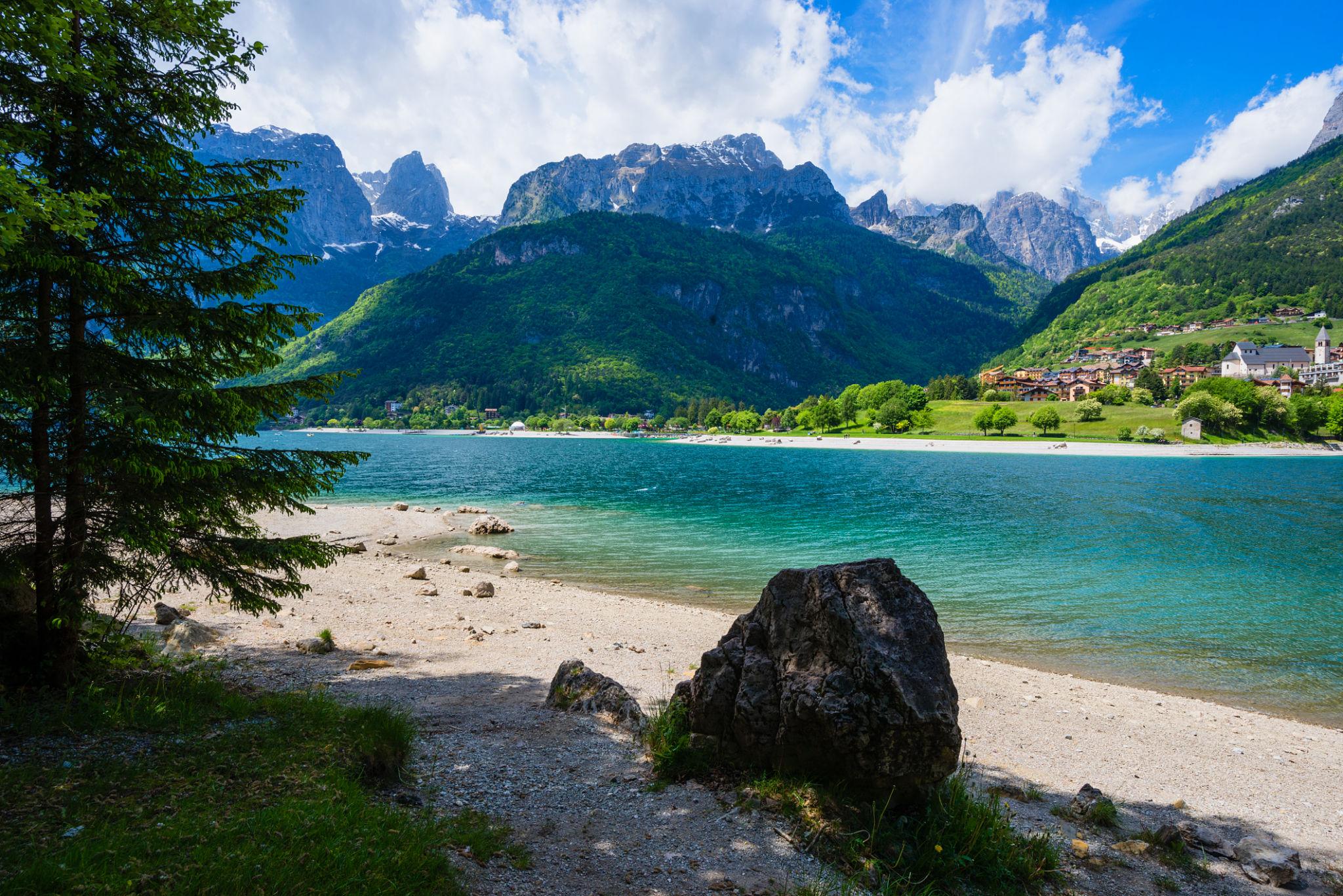
The Dolomites — shared between Trentino and the neighbouring provinces — are geologically distinct from the Alps: formed from ancient coral reefs that the African tectonic plate pushed 3,000 metres into the sky. The result is a landscape of pale grey-pink towers, impossibly vertical, that glow orange and red at sunrise and sunset. In summer they are exceptional for hiking. In winter they hold some of the finest skiing in Europe. Arte Sella, the open-air art gallery set deep in the Val di Sella forest, is unlike anything else in Italy.
April–May. Apple orchards in blossom, hiking trails opening, the lowest hotel prices of the year. The valley is warm before the mountains.
June–September. Long days, warm valleys, excellent hiking in the Dolomites, outdoor dining, and the Trento Film Festival in April. The definitive season.
October–November. Grape harvest, golden foliage, truffle season, and the apple harvest. The best season for food and wine visits to the estates.
December–March. Trento’s famous Christmas market, Madonna di Campiglio skiing, the Dolomites under snow. A genuinely different destination from the summer one.
Direct trains from Venice Santa Lucia run frequently to Trento. One of the great short rail journeys in northern Italy — the Brenner line runs through the Adige gorge with Dolomite peaks visible for much of the way. A natural pairing: Venice first, then the mountains.
Direct trains from Milan Centrale to Trento. The A22 Brenner motorway connects Milan to Trento by car in around two hours. Either option is practical; the train is more scenic and arrives in the city centre.
Fly into Venice (VCE) or Verona (VRN) — both are around 1–2 hours from Trento by road or rail. Innsbruck Airport (INN) across the Austrian border is an alternative for direct flights and is 90 minutes from Trento by car over the Brenner Pass.
Trento is the best base for the province. A car is necessary to reach the Dolomite valleys, mountain restaurants, and wine estates. The city itself is small enough to walk; public transport connects the main towns but does not reach the mountains effectively.
Trentino’s northern neighbour — an Italian city with German street signs, pastel-coloured buildings under medieval arcades, and Ötzi the Iceman in the South Tyrol Museum of Archaeology. The most un-Italian city in Italy, and one of the most interesting.
The walled city of Romeo and Juliet, the Arena, and some of the finest restaurants in the Veneto. An easy hour south of Trento by train — the Soave and Valpolicella wine estates lie between them and can be visited on the way.
The northern shore of Garda — Riva del Garda and Arco — falls within Trentino and has a microclimate mild enough for olive trees and lemon groves at the foot of 2,000-metre peaks. The most dramatic lake scenery in Italy, from the least visited end.
Two hours south by train. The obvious pairing for a week: Trentino first for mountains, wine, and open space; Venice for art, architecture, and the particular experience of being in a city built on water. Arrive in Venice at the end rather than the beginning.
90 minutes north over the Brenner Pass — the Habsburg capital of the Tyrol, with a Golden Roof, a remarkable Imperial Court Church, and a ski jump that hangs above the city. The most architecturally interesting mountain city in central Europe.
Trentino’s second city and the home of MART, one of the finest modern art museums in Italy — a building by Mario Botta that is worth the visit alone. The War History Museum covers the Dolomite front of the First World War, which was fought at altitude in these mountains.