Unfamous Places recommends
Pythagoras. Aristarchus. Epicurus. Aesop. Four of the most significant minds of antiquity from one island. A temple larger than the Parthenon. A tunnel that proves the ancient world understood trigonometry.
Pythagoras was born here in 570 BC and proved the theorem that bears his name. Aristarchus proposed that the Earth orbits the Sun — 1,800 years before Copernicus — and calculated the size of the moon and its distance from the Earth. Epicurus developed the philosophy of tranquil pleasure and the pursuit of the good life that has been misunderstood and misappropriated ever since. Aesop told the fables. The concentration of intellectual achievement on a single Aegean island in the 6th and 5th centuries BC is without parallel in the ancient world.
The Tunnel of Eupalinos — built in the 6th century BC by the engineer Eupalinos of Megara to carry water to Samos town — was dug from both ends of a mountain simultaneously. The two teams met inside the mountain with a horizontal error of less than 60 centimetres and a vertical error of less than half a metre. Herodotus listed it as one of the three greatest engineering works in the Greek world. It was only rediscovered in 1882. You can walk through it. Most visitors to Samos do not know it exists.
The sanctuary of Hera at the southwestern end of the island was one of the largest temples in the ancient Greek world — its final version, the Polycratean temple begun in the 6th century BC, was 112 metres long and 55 metres wide, larger than the Parthenon in Athens. Only one column still stands; the foundations and the stone field around it are UNESCO World Heritage. The combination of the archaeological site, the morning light on the remains, and the complete absence of crowds makes it one of the most moving ancient sites in Greece.
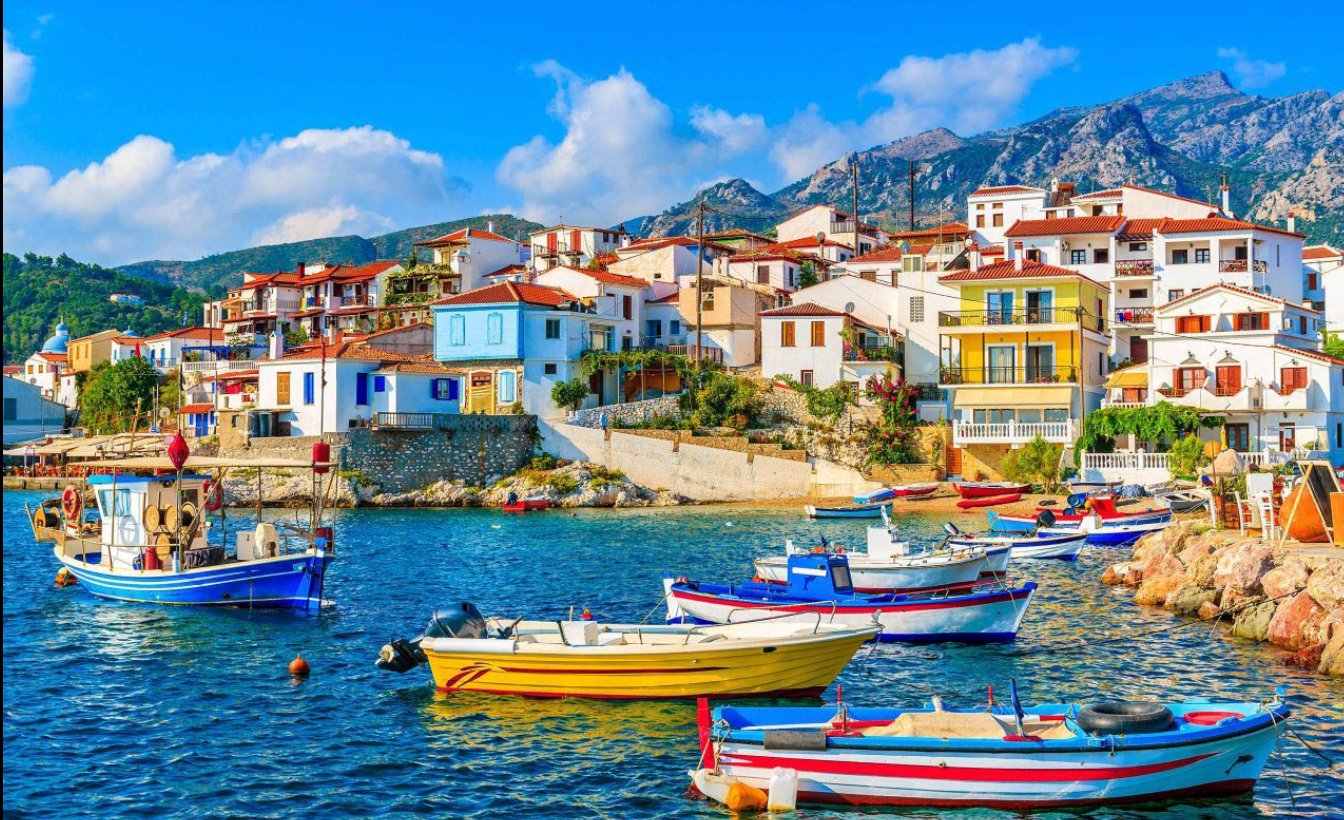
Samos is the greenest island in the eastern Aegean — fed by mountain springs, covered in pine and olive forests, with a dramatic central massif (Mount Kerkis, 1,434m) visible from every part of the island. The northern coast has some of the finest pebble beaches in the Aegean, accessible on clear days with the Turkish coast twelve miles away. The Muscat wine for which the island has been famous since the Venetians is still produced by the Samos Union of Winemaking Cooperatives, one of the oldest wine cooperatives in Greece.
Everything open, almost no tourists, the island intensely green from the spring rains, the sea warm enough to swim. The best month to come.
Peak quality. Long days, clear water, tavernas at their best. Crowds beginning to arrive but manageable; the archaeological sites are still quiet in the mornings.
High season. The island is livelier, the beaches fuller, and the prices higher. The evening atmosphere in Kokkari and Pythagorion is excellent; the Heraion at dawn is empty.
The finest month. Warm sea, golden light, the harvest under way, crowds gone. The north coast beaches at their most beautiful. The ideal time for first-time visitors.
Seasonal direct charter flights from London, Manchester, and other UK cities run from May to October. Airlines including TUI, Jet2, and easyJet operate direct services. The airport is 3km from Pythagorion and 25km from Vathy. A hire car from the airport is the most practical way to explore the island.
Year-round connections from Athens Eleftherios Venizelos to Samos Airport. If combining with Athens, a return to Samos by air is straightforward; the ferry from Piraeus takes 9–11 hours and is best avoided unless you have a cabin.
A hire car is necessary for reaching the Heraion, the Tunnel of Eupalinos, the mountain villages, and the best beaches. The island is 43km east-west; most drives between key points take 30–45 minutes. Book a car at the airport in advance in peak season — availability can be tight in July and August.
Daily ferries run between Samos (Vathy port) and Kušadasi in Turkey — a 1-hour crossing. This makes a day trip to the ruins of Ephesus practical and excellent: one of the finest ancient cities in the world, twenty minutes from the Turkish port. Bring your passport.
The island of Odysseus — two hours away by ferry or a short flight. The natural Ionian counterpart to Samos in the eastern Aegean: literary associations, small harbours, the absence of mass tourism. The two islands together make a fine week.
The island of longevity — one of the world’s five Blue Zones, where people live measurably longer than anywhere else in Europe. A short ferry hop from Samos: unhurried, independent-minded, and with some of the best panigiri (village festival) culture in Greece.
One of the finest ancient cities in the world — one hour by ferry from Vathy to Kušadasi, then twenty minutes by taxi to the ruins. The Library of Celsus, the Grand Theatre, the marble streets. Bring your passport; Turkish visas are available on arrival for most EU and UK passport holders.
A tiny archipelago between Samos and Ikaria — twelve inhabited islands, exceptional fresh fish served directly from the boats at the small harbour tavernas, and a complete absence of tourist infrastructure. The finest raw seafood in the eastern Aegean.
The mastic island — the only place in the world where Pistacia lentiscus trees produce the resin that has been used in Mediterranean cooking and medicine since antiquity. The medieval mastic villages (Mastichochoria) in the south of the island are UNESCO-listed.
The tiny uninhabited islets off the Samos coast — reached by local boat trip, with crystal water, no facilities, and the kind of solitude that has become impossible to find on larger Greek islands. Ask at any harbour about boat trips.